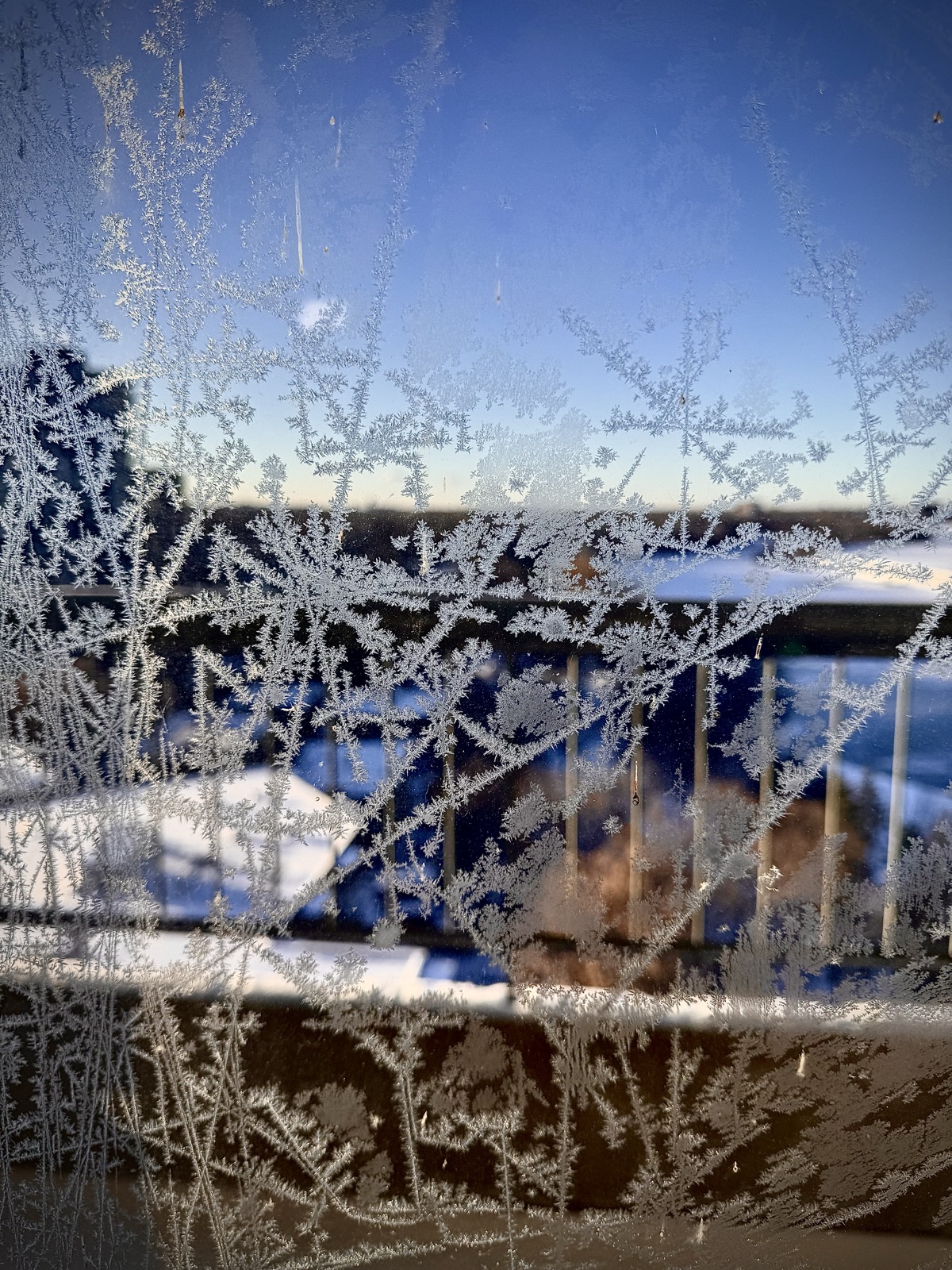
On a cold winter morning, the glass of my window becomes a canvas for one of nature's most elegant demonstrations of non-equilibrium physics. Frost crystals—intricate, branching structures that seem almost organic—emerge spontaneously from the interplay of thermodynamics, kinetics, and molecular geometry. This is the mathematics behind the magic.
I. The Thermodynamic Driving Force
The process begins with supersaturation. The air near my cold window contains water vapor at some partial pressure $p_v$, while the equilibrium vapor pressure over ice at the glass temperature is $p_{\text{sat}}(T)$. The supersaturation ratio determines whether deposition can occur:
When $S > 1$, the system is out of equilibrium and ice will form. The equilibrium vapor pressure follows the Clausius-Clapeyron equation:
\(L_s\) — latent heat of sublimation
\(R\) — universal gas constant
\(T\) — absolute temperature
This equation encodes an exponential sensitivity: a few degrees colder on the glass dramatically increases the thermodynamic driving force for ice formation. The window becomes a site of profound disequilibrium.
II. Nucleation Dynamics
Before crystals can grow, they must nucleate. Classical nucleation theory gives the free energy barrier for forming a critical nucleus:
\(\gamma\) — ice-vapor surface energy
\(v_m\) — molecular volume of ice
\(k_B\) — Boltzmann constant
\(S\) — supersaturation ratio
The nucleation rate follows an Arrhenius form, describing the probability per unit time of a critical nucleus forming:
Heterogeneous Nucleation
On my window, heterogeneous nucleation dominates—dust particles, scratches, and surface imperfections lower $\Delta G^*$ dramatically by providing favorable geometry. This is why frost patterns often originate from specific, seemingly random points on the glass.
III. The Diffusion Field
Once a nucleus exists, growth is governed by how water molecules reach the interface. The vapor concentration field $c(\mathbf{r}, t)$ obeys the diffusion equation:
where $D \approx 2 \times 10^{-5}$ m²/s for water vapor in air. For the quasi-steady growth typical of frost formation—where diffusion is fast compared to interface motion—this reduces to Laplace's equation:
This deceptively simple equation, subject to the boundary conditions $c = c_\infty$ far from the crystal and $c = c_{\text{eq}}(T)$ at the ice surface, is the mathematical origin of all the complexity to come.
IV. The Mullins-Sekerka Instability
Here is where the magic happens. A flat interface growing into a supersaturated field is unstable. Consider a small sinusoidal perturbation of amplitude $\delta$ and wavenumber $k$ on an otherwise planar front. The growth rate of this perturbation is:
\(\Omega\) — molecular volume
\(d_0\) — capillary length
\(\Gamma = \gamma T_m / (L_s \rho_s)\) — surface tension parameter
The physics encoded in this equation is profound:
Two Competing Effects
The first term ($|k|$) is destabilizing: protrusions stick out into regions of higher concentration gradient and grow faster—a positive feedback loop.
The second term ($-\Gamma k^2$) is stabilizing: surface tension penalizes high curvature, smoothing out the sharpest features.
The most unstable wavelength—the characteristic spacing between dendrite branches—occurs at:
This sets the characteristic spacing between dendrite branches—typically tens of micrometers for ice. The pattern I see on my window is not arbitrary; it is selected by a competition between diffusive instability and surface tension.
V. Full Interface Dynamics
The complete evolution requires tracking the moving boundary. The interface velocity $v_n$ normal to the surface is given by the Stefan condition—mass conservation at the boundary:
The concentration gradient at the surface depends on the global solution to Laplace's equation, which in turn depends on the interface shape. This nonlocal coupling—where the growth at any point depends on the entire crystal geometry—is what makes the dynamics so rich.
The Gibbs-Thomson condition modifies the boundary concentration based on local curvature $\kappa$:
High curvature (sharp tips) raises the local equilibrium concentration, slightly suppressing growth there—but this effect is weak compared to the diffusive instability, so tips still win the competition for growth.
VI. Crystallographic Anisotropy
Ice has hexagonal crystal structure (space group $P6_3/mmc$), and the surface energy $\gamma$ depends on crystallographic orientation. This anisotropy is crucial for pattern selection. A common parameterization:
\(\theta\) — angle in the basal plane
\(\epsilon \sim 0.01\text{-}0.05\) — anisotropy strength
This weak anisotropy gets amplified by the growth dynamics to produce the characteristic six-fold symmetric dendrites. The anisotropy enters through a modified Gibbs-Thomson condition:
The stiffness term $\gamma + \partial^2 \gamma / \partial \theta^2$ can become negative for certain orientations at high anisotropy, leading to forbidden growth directions and faceted crystals. The hexagonal symmetry of snowflakes is a direct manifestation of this molecular-scale information being amplified to macroscopic pattern.
VII. Heat Transport Coupling
Sublimation releases latent heat, so there's a coupled temperature field that evolves according to the heat equation:
At the interface, energy conservation requires:
The Thermal Reservoir
For frost on glass, the thermal problem is somewhat simplified because the glass acts as a large thermal reservoir. But the latent heat release does create local temperature variations that feed back into the vapor pressure field through the Clausius-Clapeyron equation—a coupling between the mass and heat transport problems.
VIII. Phase Field Formulation
Modern simulations often use a phase field approach, introducing an order parameter $\phi$ that smoothly transitions from $\phi = 0$ (vapor) to $\phi = 1$ (solid). The dynamics follow coupled evolution equations:
\(u\) — dimensionless supersaturation field
\(W\) — interface width
\(\tau\) — relaxation time
\(\lambda\) — coupling constant
Anisotropy enters through making $W$ and $\tau$ orientation-dependent:
This formulation naturally handles topology changes—branch merging, sidebranching, tip-splitting—that sharp-interface models struggle with. It has become the workhorse of computational crystal growth research.
IX. Sidebranching and Noise
The dendrite arms you see aren't smooth—they have secondary branches, tertiary branches, and so on, in a fractal cascade. This sidebranching arises from selective amplification of noise.
Thermal fluctuations or slight variations in the vapor field perturb the interface. The Mullins-Sekerka mechanism then amplifies perturbations at the unstable wavelength. The spacing between sidebranches scales as:
\(v_{\text{tip}}\) — dendrite tip velocity
\(d_0\) — capillary length
Noise as Creative Force
Faster growth gives finer sidebranching. The noise that seeds these structures is thermal—molecular-scale randomness—yet it gets organized by the deterministic dynamics into coherent, large-scale pattern. Chaos and order are not opposites here; they are collaborators.
X. Synthesis: Why My Window Shows This Pattern
Several factors conspire to produce the frost crystals on my window:
Temperature Gradients
The temperature gradient across the glass thickness creates varying supersaturation. The outer surface is coldest, but frost forms on the inner surface where warm, moist indoor air meets cold glass. The precise thermal profile determines local driving force.
Convective Transport
Convective air currents in the room affect vapor transport to the surface, potentially creating large-scale organization of nucleation sites. The pattern reflects not just local physics but the global flow field of my room.
Quasi-2D Geometry
The quasi-two-dimensional geometry—growth constrained to the glass surface—differs from bulk dendritic growth. Branches that would extend into 3D are forced to compete for diffusion field in the plane, intensifying the screening effects between neighboring dendrites.
Slow Overnight Growth
Slow overnight growth allows the system to explore near-equilibrium morphologies. Rapid cooling would produce more disordered, less crystallographically-aligned structures. My patient frost has had time to find its preferred forms.
A Dissipative Structure
The frost pattern is an emergent attractor of the coupled PDEs—not encoded in the equations but arising from their dynamics. Small perturbations (dust particles, scratches) create sensitive dependence on initial conditions, giving each frost pattern its uniqueness while the statistical properties (branch spacing, growth rates, symmetry) remain reproducible.
The frost is a dissipative structure in Prigogine's sense—it maintains its organized form only through continuous entropy production: heat flowing from inside to outside, matter flowing from vapor to solid. Cut off the temperature gradient and it sublimates away, returning to equilibrium. Its beauty exists only at the edge of equilibrium, sustained by flow.
Every frost crystal on my window is a frozen record of these dynamics—a snapshot of non-equilibrium thermodynamics made visible. The equations above, austere in their mathematical form, contain within them the capacity for infinite variation: no two frost patterns will ever be identical, yet all of them speak the same physical language.
The next time you see frost on glass, you are witnessing one of the most beautiful demonstrations of how simple physical laws—diffusion, surface tension, crystallography—can conspire to produce complexity that feels almost alive. The pattern is not designed; it is discovered by the physics itself, an attractor in the space of possible forms.
If you read this far, you'd probably like the newsletter. One email per week. Free.